
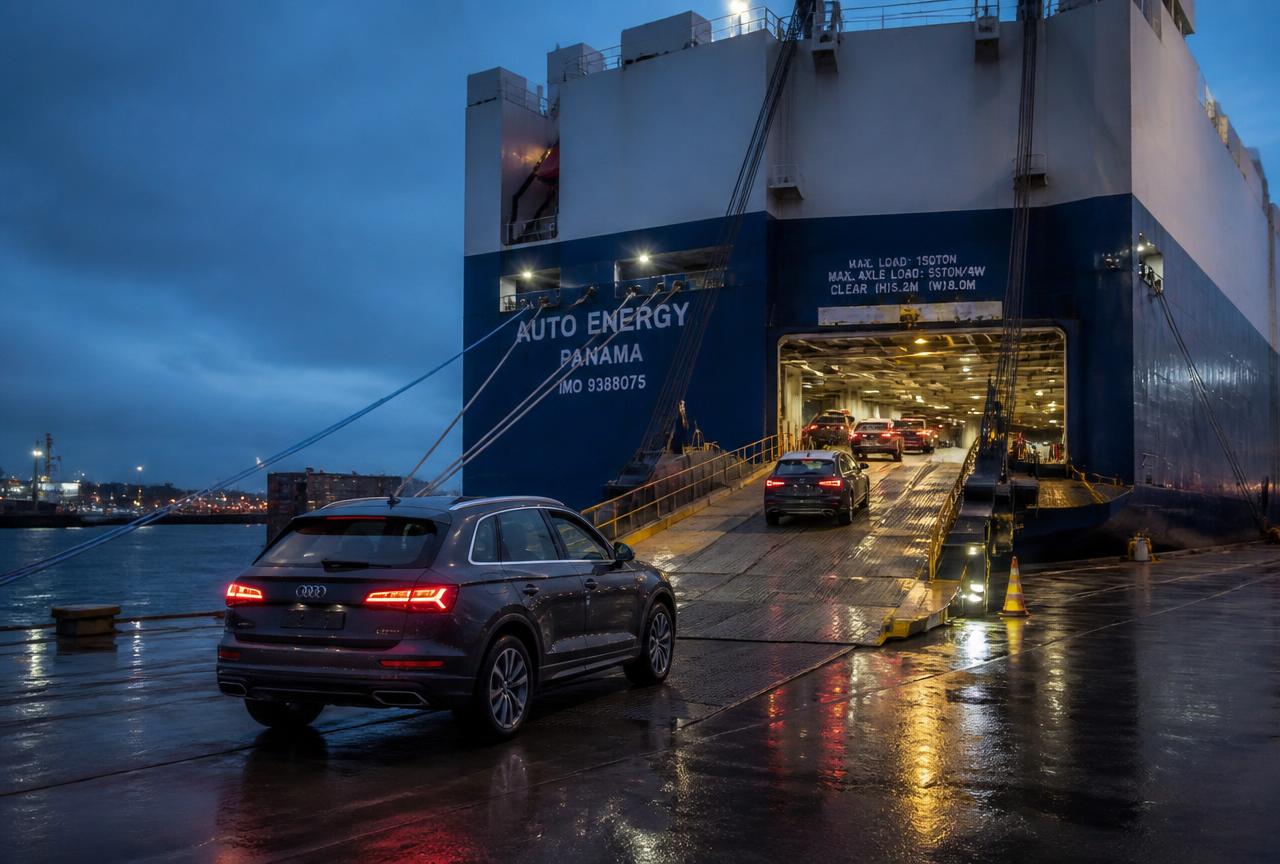
RoRo cargo service
Car Shipping from the UK to Worldwide Destinations
Roll-on roll-off and container vehicle shipping for cars, 4x4s, vans, motorhomes, trucks and agricultural machinery.
As a UK car shipping specialist, Car Shipping Direct ships vehicles out of the United Kingdom every week. Roll-on roll-off remains the most economical route for anything that starts and steers: the unit is driven onto a purpose-built car carrier, lashed to a fixed deck and driven off at the destination port. For non-runners, high-value or accessorised vehicles we load into 20ft and 40ft containers at our own East Tilbury yard.
Pricing guide
Vehicle Shipping Pricing Guide
RoRo and containerised car shipping from Tilbury, Southampton, Sheerness and Liverpool
| Saloon / hatchback carRoRo, UK port to destination port | from £695 |
| 4x4, SUV & pick-upPriced on cubic measurement | from £890 |
| Van, minibus & motorhomeHeight and length surcharges apply | from £1,150 |
| Motorbike (crated or shared container) | from £395 |
| Truck, tractor & plant machineryRoRo or flat rack | from £1,450 |
| Two cars in a shared 40ft containerLoaded and braced at Tilbury | from £1,950 |
| Marine insurance | 1.5% of declared value |
Indicative rates only, excluding VAT where applicable. Final pricing depends on dimensions, weight, sailing schedule and destination charges.
We help private owners and trade customers ship cars UK-wide, collecting from any address, dealership, auction house, private driveway or fleet yard. Customers comparing ShipCars UK services receive the same practical support: collection, export paperwork and delivery to the loading berth that gives the earliest sailing. Southampton, Tilbury, London Gateway, Immingham, Bristol and Sheerness all feature in our weekly schedule, so a vehicle rarely waits more than a few days for space.
UK ports we load from
We hold weekly sailings from six principal berths, chosen so that a vehicle collected anywhere in the UK reaches a loading terminal within a day.
- Southampton, the largest RoRo terminal in the UK, with services to West Africa, the Middle East and the Caribbean.
- Tilbury & London Gateway, our home port, minutes from our East Tilbury vehicle compound and container yard, with sailings covering the Mediterranean, East and West Africa and the Gulf.
- Immingham, the principal RoRo gateway for Scandinavia and the Baltic.
- Bristol (Portbury), used for selected North and West African rotations.
- Sheerness, container and RoRo capacity for shorter European and Mediterranean crossings.
Vehicles and units we ship
RoRo, container or breakbulk, depending on the size and condition of the unit.
- Cars, saloons, hatchbacks and prestige vehicles
- 4x4s, SUVs, pick-ups and crew cabs
- Vans, minibuses and light commercials
- Motorhomes, campervans and RVs
- Rigid trucks, tippers and tractor units
- Agricultural tractors, combines and implements
- Excavators, loaders and construction plant
- Motorcycles, quads and jet skis (crated or shared)
- Boats, yachts and trailers on cradles
- Electric and hybrid vehicles with SoC compliance
RoRo versus container shipping
RoRo is cheaper, faster to book and involves no packing. The trade-off is that nothing loose may travel inside the vehicle, and the unit must be roadworthy with working brakes and steering. Container shipping costs more but protects the vehicle completely, allows personal effects and spares to travel alongside it, and is the only realistic option for classic cars, salvage units and vehicles going to ports without a RoRo terminal.
When we recommend RoRo
- The vehicle is roadworthy, taxed for movement and can be driven under its own power.
- You want the lowest possible freight cost and do not need to send accompanying items.
- Your destination port operates a RoRo ramp, most West African, Gulf and Mediterranean ports do.
When we recommend a container
- The vehicle is a non-runner, a classic, a salvage title or has modified suspension.
- You need to send wheels, spares, tools or personal effects alongside the vehicle.
- Theft and weather exposure in transit or at the destination terminal are a concern.
- The destination country does not operate scheduled RoRo services.
Transit times
Sailing time depends on the loading port, the shipping line's rotation and whether the vessel calls direct or via a transhipment hub. As a guide: Western Europe 3–7 days, West Africa 14–21 days, East and Southern Africa 21–30 days, the Middle East and Gulf 10–18 days, the Caribbean and North America 12–20 days, and Australia and New Zealand 35–45 days. We confirm the vessel name, voyage number and estimated arrival date in writing at the time of booking, not after the ship has sailed.
Documentation and export formalities
To export a UK-registered vehicle we need the V5C logbook, photographic ID for the owner, and the purchase invoice where the vehicle is being sold. We surrender the V5C to the DVLA, complete the HMRC export declaration and issue a bill of lading that names your consignee. If the vehicle is on finance, a letter of no interest from the lender is required before it can be loaded.
Documents you will typically need
- Original V5C registration certificate (logbook)
- Passport or photographic driving licence for the registered keeper
- Purchase invoice or bill of sale where ownership has recently changed
- Finance settlement letter or letter of no interest, where applicable
- MOT certificate or export MOT, where the destination requires one
- Import permit or pre-shipment inspection booking for certain destination markets
Preparing your vehicle for collection
A little preparation avoids delay at the terminal gate. Fuel should be at a quarter of a tank or less, alarms disabled or codes provided, and the vehicle clean inside and out — many destination customs authorities reject vehicles carrying soil, seeds or organic matter under ISPM15-style biosecurity rules. Personal belongings must not travel loose inside a RoRo unit; anything you want to send must go into a container instead.
- Fuel tank no more than a quarter full
- Battery connected, charged and terminals secure
- No loose items left inside the cabin or boot for RoRo shipments
- Existing damage, mileage and accessories photographed at collection
- Spare key handed to the driver, or confirmed as travelling separately
How vehicle shipping works
Quote & booking
Rates, sailing or flight options confirmed in writing.
UK collection
Nationwide collection or delivery into our Tilbury depot.
Loading & packing
Lashing, crating, palletising and photographic record.
Customs & export
Export entry, NES clearance and documentation released.
Transit & delivery
Tracking updates until the cargo lands with your consignee.
Loading, lashing and the compound
Every vehicle passing through our East Tilbury compound is logged in, photographed on all four corners plus the dashboard, and checked against the booking before it goes anywhere near a vessel. RoRo units are lashed to the car deck with four-point webbing to the carrier's specification; container loads are wheel-chocked, ratchet-strapped to the floor rings and, where more than one vehicle shares a box, separated with plywood bulkheads to prevent contact damage in transit.
Marine insurance
Carrier liability is limited and rarely reflects the true value of a vehicle. We offer all-risk marine cover at 1.5% of the declared CIF value, subject to a minimum premium, covering total loss and damage from the moment the vehicle is collected until it is discharged at the destination port.
What affects your premium and your freight rate
- Declared value of the vehicle and any accessories fitted
- Vehicle dimensions, height and length in particular drive RoRo lane-metre pricing
- Whether the unit is a runner (RoRo) or a non-runner (container or breakbulk)
- Choice of shared or exclusive-use container
- Loading port and destination port combination and sailing frequency
- Seasonal demand, Q4 and pre-Ramadan periods see higher carrier tariffs
Insurance options for owners and traders
Beyond our standard all-risk cover, dealers and private owners shipping high-value or classic vehicles can request an agreed-value policy that fixes the settlement figure in advance rather than relying on a post-loss valuation, which removes disputes over depreciation after a total loss.
Storage before and after sailing
Vehicles can be held at our East Tilbury compound before the confirmed sailing date, and equally at the destination agent's yard after discharge, for a modest daily rate. This is useful where a buyer's finance or import licence is still being finalised and you would rather hold the vehicle securely than release the booking and lose the sailing slot.
Trade and dealer accounts
Dealers, auction houses and export traders who move several vehicles a month can open a trade account with staged invoicing, consolidated container loading to reduce per-vehicle cost, and a single point of contact for the whole programme. We can also hold vehicles at our compound for a modest daily rate while a buyer's payment or import licence is finalised, rather than releasing the berth and losing the sailing.
Frequently asked questions
Can I ship a car with a finance agreement still running?
Yes, provided the finance company issues a letter confirming they have no objection to the vehicle being exported. We can request this on your behalf if you give us the agreement number and the lender's contact details.
Do I need to be present when the vehicle is collected?
No. Our driver will complete the condition report and take the keys and documents from whoever is nominated on the booking, whether that is you, a dealership or a third party.
What happens if my vehicle fails the pre-shipment inspection?
We tell you immediately and hold the vehicle at our compound rather than loading it. In most cases the issue, an oil leak, excess fuel, a flat battery, can be rectified on-site so the vehicle still makes the intended sailing.
Why ship with Car Shipping Direct
Car Shipping Direct LTD trades as Car Shipping Direct from our own vehicle compound and container yard at East Tilbury, a short drive from the port. That means your vehicle is inspected, photographed, loaded and, where needed, containerised on one site rather than passing through a chain of subcontractors. You deal with one coordinator from quotation to proof of delivery, and every stage, collection, gate-in, sailing, arrival, is confirmed to you in writing.
Shipping Cars to, 198 Destination Countries
Select a destination for schedules, indicative rates and a tailored quotation. Countries not listed are still served weekly, contact our desk for a bespoke routing.
Africa
- Shipping Cars to Algeria12 days
- Shipping Cars to Angola24 days
- Shipping Cars to Benin19 days
- Shipping Cars to Botswana34 days
- Shipping Cars to Burkina Faso24 days
- Shipping Cars to Burundi32 days
- Shipping Cars to Cameroon21 days
- Shipping Cars to Cape Verde14 days
- Shipping Cars to Central African Republic34 days
- Shipping Cars to Chad34 days
- Shipping Cars to Comoros32 days
- Shipping Cars to Democratic Republic of the Congo26 days
- Shipping Cars to Djibouti24 days
- Shipping Cars to Egypt18 days
- Shipping Cars to Equatorial Guinea23 days
- Shipping Cars to Eritrea28 days
- Shipping Cars to Eswatini32 days
- Shipping Cars to Ethiopia26 days
- Shipping Cars to Gabon22 days
- Shipping Cars to Gambia17 days
- Shipping Cars to Ghana21 days
- Shipping Cars to Guinea18 days
- Shipping Cars to Guinea-Bissau19 days
- Shipping Cars to Ivory Coast21 days
- Shipping Cars to Kenya26 days
- Shipping Cars to Lesotho32 days
- Shipping Cars to Liberia19 days
- Shipping Cars to Libya18 days
- Shipping Cars to Madagascar30 days
- Shipping Cars to Malawi35 days
- Shipping Cars to Mali26 days
- Shipping Cars to Mauritania17 days
- Shipping Cars to Mauritius29 days
- Shipping Cars to Morocco10 days
- Shipping Cars to Mozambique30 days
- Shipping Cars to Namibia30 days
- Shipping Cars to Niger27 days
- Shipping Cars to Nigeria22 days
- Shipping Cars to Republic of the Congo23 days
- Shipping Cars to Reunion29 days
- Shipping Cars to Rwanda32 days
- Shipping Cars to Sao Tome and Principe24 days
- Shipping Cars to Senegal18 days
- Shipping Cars to Seychelles28 days
- Shipping Cars to Sierra Leone18 days
- Shipping Cars to Somalia30 days
- Shipping Cars to South Africa28 days
- Shipping Cars to South Sudan32 days
- Shipping Cars to Sudan26 days
- Shipping Cars to Tanzania28 days
- Shipping Cars to Togo19 days
- Shipping Cars to Tunisia12 days
- Shipping Cars to Uganda30 days
- Shipping Cars to Zambia34 days
- Shipping Cars to Zimbabwe33 days
Asia
- Shipping Cars to Afghanistan32 days
- Shipping Cars to Armenia26 days
- Shipping Cars to Azerbaijan28 days
- Shipping Cars to Bangladesh28 days
- Shipping Cars to Bhutan30 days
- Shipping Cars to Brunei32 days
- Shipping Cars to Cambodia31 days
- Shipping Cars to China30 days
- Shipping Cars to Georgia20 days
- Shipping Cars to Hong Kong28 days
- Shipping Cars to India24 days
- Shipping Cars to Indonesia30 days
- Shipping Cars to Japan33 days
- Shipping Cars to Kazakhstan32 days
- Shipping Cars to Kyrgyzstan34 days
- Shipping Cars to Laos33 days
- Shipping Cars to Macau31 days
- Shipping Cars to Malaysia28 days
- Shipping Cars to Maldives26 days
- Shipping Cars to Mongolia36 days
- Shipping Cars to Myanmar30 days
- Shipping Cars to Nepal32 days
- Shipping Cars to Pakistan24 days
- Shipping Cars to Philippines32 days
- Shipping Cars to Singapore26 days
- Shipping Cars to South Korea32 days
- Shipping Cars to Sri Lanka26 days
- Shipping Cars to Taiwan31 days
- Shipping Cars to Tajikistan35 days
- Shipping Cars to Thailand28 days
- Shipping Cars to Turkmenistan33 days
- Shipping Cars to Uzbekistan33 days
- Shipping Cars to Vietnam30 days
Caribbean
- Shipping Cars to Antigua and Barbuda19 days
- Shipping Cars to Aruba21 days
- Shipping Cars to Bahamas18 days
- Shipping Cars to Barbados18 days
- Shipping Cars to Cayman Islands20 days
- Shipping Cars to Cuba22 days
- Shipping Cars to Curacao21 days
- Shipping Cars to Dominica20 days
- Shipping Cars to Dominican Republic20 days
- Shipping Cars to Grenada21 days
- Shipping Cars to Haiti21 days
- Shipping Cars to Jamaica20 days
- Shipping Cars to Puerto Rico18 days
- Shipping Cars to Saint Kitts and Nevis19 days
- Shipping Cars to Saint Lucia19 days
- Shipping Cars to Saint Vincent and the Grenadines20 days
- Shipping Cars to Trinidad and Tobago21 days
- Shipping Cars to Virgin Islands (British)20 days
Central America
Europe
- Shipping Cars to Albania14 days
- Shipping Cars to Andorra7 days
- Shipping Cars to Austria9 days
- Shipping Cars to Belarus12 days
- Shipping Cars to Belgium3 days
- Shipping Cars to Bosnia and Herzegovina13 days
- Shipping Cars to Bulgaria13 days
- Shipping Cars to Croatia11 days
- Shipping Cars to Cyprus14 days
- Shipping Cars to Czechia8 days
- Shipping Cars to Denmark5 days
- Shipping Cars to Estonia8 days
- Shipping Cars to Finland8 days
- Shipping Cars to France3 days
- Shipping Cars to Germany4 days
- Shipping Cars to Gibraltar8 days
- Shipping Cars to Greece12 days
- Shipping Cars to Greenland18 days
- Shipping Cars to Hungary11 days
- Shipping Cars to Iceland9 days
- Shipping Cars to Ireland2 days
- Shipping Cars to Italy8 days
- Shipping Cars to Kosovo15 days
- Shipping Cars to Latvia8 days
- Shipping Cars to Liechtenstein7 days
- Shipping Cars to Lithuania8 days
- Shipping Cars to Luxembourg4 days
- Shipping Cars to Malta12 days
- Shipping Cars to Moldova14 days
- Shipping Cars to Monaco5 days
- Shipping Cars to Montenegro13 days
- Shipping Cars to Netherlands3 days
- Shipping Cars to North Macedonia14 days
- Shipping Cars to Norway6 days
- Shipping Cars to Poland7 days
- Shipping Cars to Portugal8 days
- Shipping Cars to Romania12 days
- Shipping Cars to Russia20 days
- Shipping Cars to Serbia13 days
- Shipping Cars to Slovakia10 days
- Shipping Cars to Slovenia10 days
- Shipping Cars to Spain6 days
- Shipping Cars to Sweden6 days
- Shipping Cars to Switzerland9 days
- Shipping Cars to Turkey14 days
- Shipping Cars to Ukraine16 days
Middle East
- Shipping Cars to Bahrain22 days
- Shipping Cars to Iran28 days
- Shipping Cars to Iraq26 days
- Shipping Cars to Israel16 days
- Shipping Cars to Jordan20 days
- Shipping Cars to Kuwait23 days
- Shipping Cars to Lebanon17 days
- Shipping Cars to Oman22 days
- Shipping Cars to Qatar22 days
- Shipping Cars to Saudi Arabia21 days
- Shipping Cars to Syria26 days
- Shipping Cars to United Arab Emirates21 days
- Shipping Cars to Yemen28 days
North America
- Shipping Cars to Belize24 days
- Shipping Cars to Bermuda16 days
- Shipping Cars to Canada18 days
- Shipping Cars to Costa Rica24 days
- Shipping Cars to El Salvador26 days
- Shipping Cars to Guatemala25 days
- Shipping Cars to Honduras24 days
- Shipping Cars to Mexico22 days
- Shipping Cars to Nicaragua26 days
- Shipping Cars to United States16 days
Oceania
- Shipping Cars to Australia38 days
- Shipping Cars to Fiji42 days
- Shipping Cars to French Polynesia44 days
- Shipping Cars to Marshall Islands46 days
- Shipping Cars to New Zealand42 days
- Shipping Cars to Papua New Guinea42 days
- Shipping Cars to Samoa44 days
- Shipping Cars to Solomon Islands44 days
- Shipping Cars to Tonga45 days
- Shipping Cars to Vanuatu44 days
South America
- Shipping Cars to Argentina32 days
- Shipping Cars to Bolivia34 days
- Shipping Cars to Brazil28 days
- Shipping Cars to Chile33 days
- Shipping Cars to Colombia24 days
- Shipping Cars to Ecuador26 days
- Shipping Cars to Guyana24 days
- Shipping Cars to Paraguay34 days
- Shipping Cars to Peru30 days
- Shipping Cars to Suriname24 days
- Shipping Cars to Uruguay32 days
- Shipping Cars to Venezuela23 days