
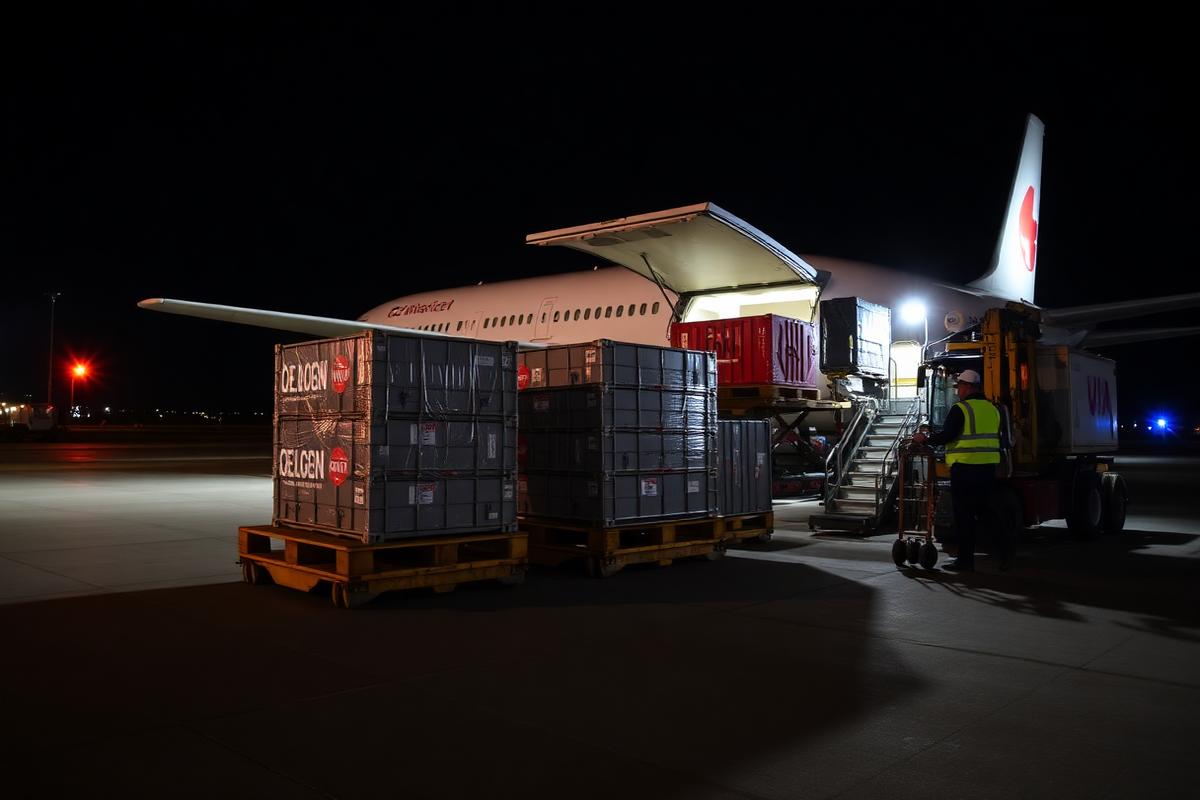
Actual weight versus volumetric weight
Aircraft run out of usable cargo space long before they run out of lift capacity, so airlines price cargo on whichever figure is greater between two calculations: the scale weight of the consignment as measured on a warehouse scale, or its volumetric weight, which is a proxy for how much of the aircraft's limited hold volume the shipment occupies. Volumetric weight is calculated by multiplying length, width and height in centimetres and dividing the result by 6,000, a divisor set by IATA and used consistently across the industry for air cargo, as distinct from the different divisors used for courier parcel services. A carton measuring 60 by 40 by 50 centimetres gives a volume of 120,000 cubic centimetres, which divided by 6,000 produces a chargeable weight of 20 kilograms even if the carton, once weighed, is found to contain only eight kilograms of actual product.
Pricing guide
Shipping Pricing Guide
Indicative UK export rates across air freight, vehicle shipping and container shipping
| Saloon car — RoRoUK port to destination port | from £695 |
| 20ft container (FCL) | from £1,450 |
| 40ft container (FCL) | from £2,050 |
| 40ft high cube container | from £2,190 |
| LCL groupageMinimum 2 m³ | from £95 per m³ |
| Air freight general cargo300 kg and above | from £2.85 per kg |
| UK collection & export entry | from £110 combined |
Indicative rates only, excluding VAT where applicable. Final pricing depends on dimensions, weight, sailing schedule and destination charges.
This divisor exists because an aircraft hold, unlike a container ship, has a hard structural limit on both weight and space, and low-density cargo, foam packaging, textiles, plastic components, empty containers destined for reuse, occupies disproportionate volume relative to its weight. Without a volumetric charging mechanism, airlines would be forced to fly holds full of light, bulky cargo at a loss relative to the space consumed, so the 6,000 divisor exists to align the price charged with the actual constraint being consumed, whichever of weight or volume happens to bind first for a given shipment.
For UK exporters shipping through Heathrow, Manchester, East Midlands or any of the UK's other cargo gateways, understanding this calculation before a shipment is packed, rather than after receiving an invoice, is the single most valuable piece of knowledge in controlling air freight cost. A shipment that looks inexpensive on a per-kilogram quoted rate can still produce an unexpectedly high invoice if its volumetric weight is several times its actual weight, and this is precisely the scenario that catches out first-time air freight shippers.
Worked examples across common cargo types
Consider a pallet of automotive spare parts measuring 120 by 100 by 150 centimetres with an actual weight of 300 kilograms. Its volumetric weight is 120 times 100 times 150, divided by 6,000, which equals 300 kilograms, in this case actual and volumetric weight are identical, and the shipper pays on actual weight with no volumetric penalty at all. This is a well-packed, dense shipment and represents the ideal outcome for anyone paying for air freight by weight.
Now consider a single carton of lightweight plastic mouldings measuring 100 by 80 by 100 centimetres weighing only 40 kilograms on the scale. Its volumetric weight is 100 times 80 times 100, divided by 6,000, which equals 133.3 kilograms, more than three times the actual weight. The airline will invoice this shipment at 133.3 kilograms chargeable weight, and no amount of arguing about the true scale weight will change the bill, because the carton occupies hold space equivalent to 133 kilograms of dense cargo regardless of what it actually weighs.
A third scenario, common in vehicle parts and accessories exports, involves oddly shaped or protruding items such as a car bonnet or a roof rack that cannot be packed into a neat cuboid. In these cases the airline measures the maximum length, width and height the item occupies including any protrusion, and charges volumetric weight on that full bounding box even though large portions of the box are empty air around an irregular shape. This is why professional export packing for air freight always aims to reduce an item to its smallest practical rectangular footprint rather than shipping it in its natural, irregular form.
Practical ways to lower chargeable weight
Choose cartons that suit the goods being shipped rather than reaching for whatever box happens to be available in the warehouse. An oversized carton around a small, dense item inflates volumetric weight for no benefit, while a carton sized closely to the product minimises the wasted cubic space that the airline will charge for regardless of whether it is occupied by product or by air. Strip out void fill such as loose paper or air pillows and replace it with dense, close-fitting protective packing where the item requires cushioning, since dense packing materials add negligible weight while allowing the overall carton dimensions to shrink.
Break down flat-packable items wherever the product design allows it, since a knocked-down item in a slim carton has dramatically lower volume than the same item shipped fully assembled. Build pallets to a tidy, uniform cube with no overhang of any box beyond the pallet's footprint, because overhanging cargo is measured and charged as if the space beneath and around it were solid, penalising the whole pallet for the sake of one carton's poor placement.
Where a consignment is genuinely light and bulky by nature and cannot be made denser through better packing, certain automotive trim panels or textile goods, for example, a consolidated groupage air service usually beats booking a direct dedicated shipment, because a consolidator combines many shippers' cargo to fill an aircraft's available volume efficiently and passes on a share of that efficiency, whereas a single light, bulky shipment booked alone pays the full volumetric penalty with no offsetting cargo to share the space.
Finally, review your packaging specification periodically rather than treating it as fixed once set. Suppliers frequently over-engineer packaging for road or sea transport, where volumetric charging is far less punishing than in air freight, and simply re-using that same packaging for an air shipment can needlessly inflate a bill that a purpose-designed carton would substantially reduce. A short packaging audit before a regular air freight lane goes into production can produce savings that recur on every single shipment thereafter.
What sits on top of the freight rate
Expect a fuel surcharge and a security surcharge charged per kilogram of chargeable weight, both of which move with global oil prices and aviation security requirements and are typically published by the airline on a monthly or even weekly basis rather than fixed for the year. There is also an airline handling and terminal fee charged at both the origin and destination airport, an export customs entry fee for the HMRC declaration, screening charges levied by a Regulated Agent or Known Consignor facility under UK aviation security law, and a fixed air waybill fee covering the documentation itself.
Dangerous goods, which in an automotive context commonly includes items such as sealed lead-acid batteries, aerosol products, or certain adhesives and sealants, attract a separate documentation and packing charge under the IATA Dangerous Goods Regulations, along with a requirement that the shipper hold a valid dangerous goods training certificate or use an agent, such as Car Shipping Direct, who holds one on their behalf. None of these additional charges are hidden or unusual, every reputable UK freight forwarder itemises them, so insist on seeing them broken out on any quotation so that you can compare like-for-like against a competing quote rather than comparing a bare freight rate against an all-inclusive one.
Destination-side charges also apply and are frequently the consignee's responsibility rather than the shipper's, depending on the agreed Incoterm. These typically include destination airport handling, customs clearance in the receiving country, and any applicable import duty and VAT. A UK exporter working on an FOB or EXW basis should make clear to the overseas buyer, before the shipment departs, exactly which charges they will be responsible for on arrival, to avoid a dispute over an unexpected destination invoice.
Air freight versus sea freight for time-critical automotive parts
Air freight's much higher chargeable weight rate compared with sea freight is easiest to justify when the cargo is small, valuable and urgently needed, a critical engine component holding up a production line, or a specialist part for a customer's vehicle that cannot wait for a multi-week sea voyage. For genuinely time-critical automotive parts shipments, the speed of air freight, typically one to five days door to door depending on origin and destination, easily outweighs its per-kilogram cost premium over sea freight, which can take four to eight weeks for the same routing.
For bulkier, less time-sensitive automotive cargo, a batch of body panels, a pallet of tyres, or a shipment of used parts for resale, sea freight in a container almost always represents better value, since the volumetric penalty that air freight imposes on bulky, low-density cargo simply does not exist in the same form for sea freight, where a 40ft container's fixed price covers its full 67 cubic metres regardless of how the space is filled.
Frequently asked questions on air freight chargeable weight
Does the 6,000 divisor apply to every airline and every shipment? It is the industry-standard divisor set by IATA for general air cargo and is used near-universally by scheduled airlines, though some courier and small-parcel services apply a different divisor, typically 5,000, which shippers should check separately if comparing an air freight quote against a courier quote for the same goods.
Can I reduce volumetric weight after the goods are already packed? Generally not without repacking, which is why the packing stage is the point of maximum control over the eventual invoice, once cartons are built and palletised, the dimensions are fixed and the airline will measure and charge on whatever is actually presented for shipment.
Is volumetric weight the same for imports as for exports? The calculation method is identical in both directions since it is a physical measurement of the cargo rather than a directional charge, though the specific surcharges applied, security, terminal handling, customs entry, will differ depending on which country's regulations apply to the leg being charged.
Will Car Shipping Direct calculate this for me before booking? Yes, as standard practice we calculate both actual and volumetric weight from your stated or measured dimensions before confirming a quotation, and we will flag where repacking could meaningfully reduce your chargeable weight before you commit to a booking.
Collection and export documentation from East Tilbury
Although air freight moves through Heathrow, Manchester or East Midlands rather than a sea port, Car Shipping Direct still coordinates the UK collection and export documentation from our East Tilbury base for automotive parts and accessories shipped by air. Goods are received, weighed and measured at our facility, where we calculate both actual and volumetric weight before the shipment is booked with the airline, so that you know the chargeable weight, and therefore the likely cost, before the cargo ever leaves the warehouse.
The HMRC export declaration must be lodged before goods are accepted by the airline's ground handling agent, and where the consignment includes items classed as dangerous goods under IATA regulations, sealed batteries, aerosols, certain adhesives, the correct dangerous goods declaration and packing certification must accompany the shipment or it will be refused at the airline's security screening point. Building in a day's margin between packing and the flight's cut-off time avoids a last-minute scramble to correct paperwork that a screening agent has flagged.
Insurance for air freight consignments
Airline liability for cargo loss or damage under the Montreal Convention is capped at a fixed rate per kilogram of the consignment's actual weight, a limit that is almost always far below the commercial value of automotive parts, particularly for compact, high-value items such as ECUs, turbochargers or specialist components. Marine and air cargo insurance, typically written at around 1% to 1.5% of the declared value for air shipments, closes this gap and is available through Car Shipping Direct on every air freight booking regardless of size.
As with sea freight, always declare the true value of the goods rather than a reduced figure to save on premium, since under-declaration triggers a proportional reduction in any eventual claim payout under the average clause common to most cargo policies.
Destination requirements for time-critical parts shipments
Shipping automotive parts by air to the United States requires the same Importer Security Filing discipline that applies to sea freight, and although the ISF rule technically applies to ocean cargo rather than air, US Customs and Border Protection still requires an Automated Manifest System filing for air shipments ahead of arrival, so US-bound air freight bookings should be confirmed with full consignee EIN or importer number details before the flight is booked to avoid a hold at the destination airport.
Shipping to Nigeria and other West African destinations by air often involves the Nigeria Customs Service's pre-arrival assessment report process, under which the value and classification of imported goods is assessed before or shortly after arrival; providing an accurate commercial invoice and correct HS classification code at the outset avoids a lengthy reassessment process that can hold time-critical parts at the airport for days.
Shipping to the UAE via Dubai or Abu Dhabi generally clears quickly provided the commercial invoice, packing list and air waybill are consistent with one another, but certain automotive parts and accessories may require a certificate of conformity depending on the receiving free zone or mainland customs authority, and this should be confirmed with the consignee before the shipment is dispatched.
Shipping to Australia by air brings the same biosecurity scrutiny that applies to sea freight for any part that has been in contact with soil, plant matter or used engine components, a used gearbox or a part removed from a vehicle that has been off-road, for example, may require cleaning certification before it will be released, and this should be arranged in the UK before dispatch rather than discovered on arrival.
Typical air freight timelines and costs in GBP
As a planning guide, a small consignment of automotive parts weighing 50 kilograms actual or chargeable, whichever is greater, moving from Heathrow to a major hub airport such as Lagos, Dubai or Sydney typically costs several hundred pounds all-in once fuel surcharge, security surcharge, terminal handling and documentation fees are included, with door-to-door transit of one to five days depending on flight frequency on the route and how quickly the consignee clears customs at the destination end.
Costs scale close to linearly with chargeable weight once past a certain minimum consignment charge that most airlines apply regardless of how small the shipment is, so consolidating several small parts orders into a single booking, where timing allows, is usually more cost-effective than shipping each one separately and paying the minimum charge repeatedly.
Common mistakes that inflate an air freight invoice
The most common and costly mistake is packing dense, valuable items into an oversized box 'just to be safe', which inflates volumetric weight for no protective benefit, a well-fitted carton with adequate but not excessive cushioning almost always beats an oversized box with loose void fill, both for cost and for genuinely reducing movement damage in transit. A close second is failing to declare dangerous goods correctly, which does not just risk a fine but can see an entire consignment pulled from a flight at the last minute when screening identifies an undeclared battery or aerosol.
Booking air freight for cargo that is not genuinely time-critical is a third avoidable cost, sea freight or a fast sea-air combination via a Gulf or Mediterranean hub is very often adequate for parts that are needed within a few weeks rather than a few days, at a fraction of the air freight rate.
Further frequently asked questions
What is the minimum chargeable weight most airlines apply? Airlines typically apply a minimum charge equivalent to somewhere between 20 and 45 kilograms chargeable weight regardless of how light or small the actual consignment is, which is why consolidating small shipments is usually more economical than sending them individually.
Do I need a commercial invoice for every air freight shipment? Yes, even a low-value parts shipment requires a commercial invoice showing an accurate description, quantity, value and HS code for both UK export declaration purposes and destination customs clearance, and an inaccurate or vague invoice is one of the most common causes of a delayed clearance at the destination airport.
Can Car Shipping Direct arrange collection from a supplier rather than from East Tilbury directly? Yes, we can arrange collection from a UK supplier's premises and consolidate the goods at our East Tilbury facility before onward air freight booking, which is particularly useful when parts are sourced from more than one UK supplier for a single overseas order.