
What actually makes up a car shipping quote
The headline number most people search for, the cost to ship a car from the UK, is only ever one line of a much longer invoice. A realistic quotation from Car Shipping Direct is built from five separate components: UK-side collection, terminal handling and loading, the ocean freight itself, export documentation, and the destination charges your consignee pays on arrival. A quote that shows only ocean freight is not cheaper, it is simply incomplete, and the missing lines have a habit of reappearing as a surprise invoice from a destination agent you have never dealt with before. When you compare two quotations, insist on seeing the same five headings on both, because a supplier who omits destination charges is not offering a lower price, they are offering an unfinished one.
Pricing guide
Shipping Pricing Guide
Indicative UK export rates across air freight, vehicle shipping and container shipping
| Saloon car — RoRoUK port to destination port | from £695 |
| 20ft container (FCL) | from £1,450 |
| 40ft container (FCL) | from £2,050 |
| 40ft high cube container | from £2,190 |
| LCL groupageMinimum 2 m³ | from £95 per m³ |
| Air freight general cargo300 kg and above | from £2.85 per kg |
| UK collection & export entry | from £110 combined |
Indicative rates only, excluding VAT where applicable. Final pricing depends on dimensions, weight, sailing schedule and destination charges.
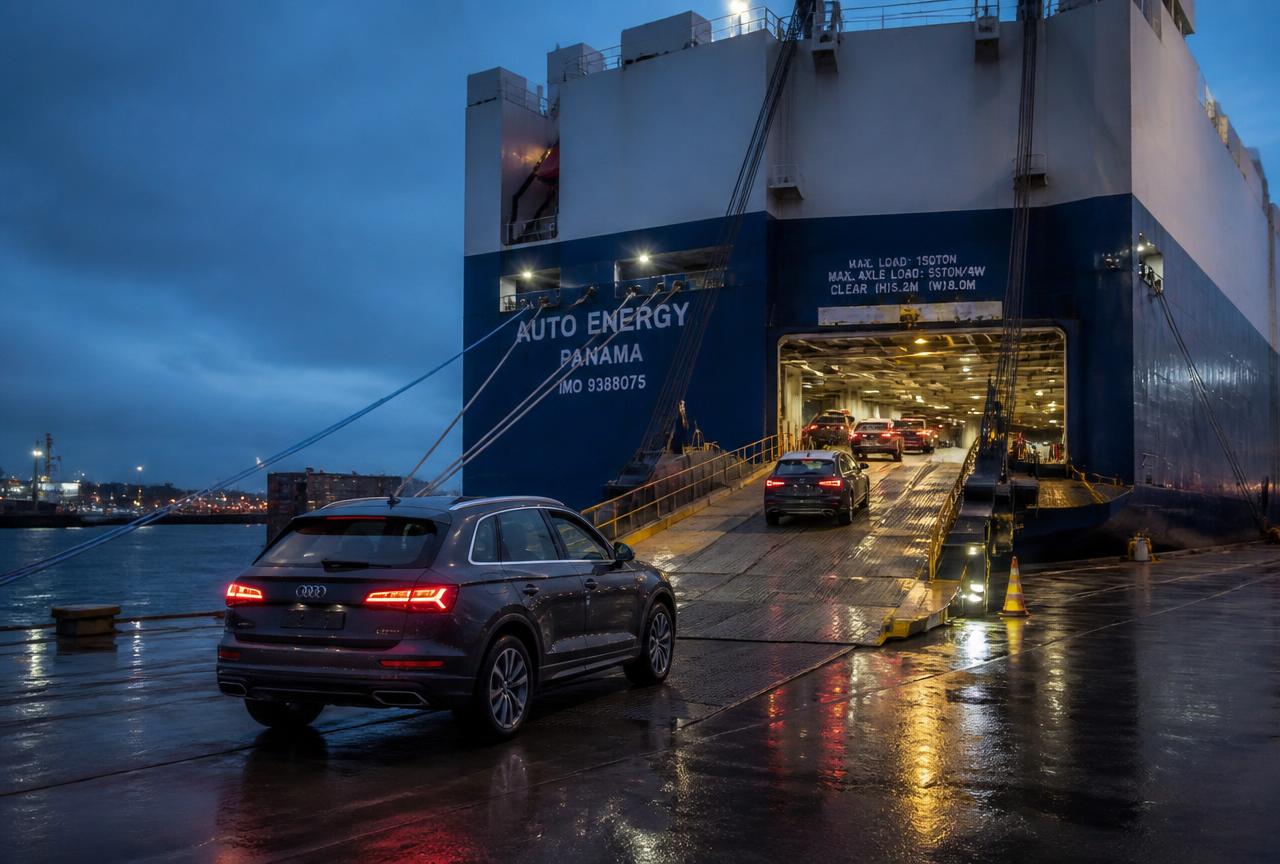
Roll-on roll-off remains the most economical method for a running vehicle leaving Britain. Because the car is driven on and lashed to a fixed deck by a trained stevedore, there is no packing labour, no container hire and no lift charge, and the freight rate reflects that simplicity. Container shipping costs more per vehicle, but the car is sealed away from weather and casual handling for the entire voyage, personal effects and spares can travel inside the same box, and non-runners or salvage units that could never be driven up a RoRo ramp can be winched in with a proper vehicle. Neither method is universally cheaper; the right one depends on the vehicle, the destination port, and how much risk you are willing to carry for the saving.
A third variable that shapes every quote is who is actually asking for it. A private individual shipping one car pays retail rates built around a single collection and a single set of paperwork. A trader or exporter moving several vehicles a month can access volume pricing, because Car Shipping Direct can consolidate collections into a single run and spread the fixed cost of a booking across multiple units. If you expect to ship more than three or four vehicles a year, it is worth asking for a standing rate agreement rather than requesting a fresh quote each time, the saving is rarely trivial once volume is genuinely repeat business.
Typical UK export price bands
As a working guide, a standard saloon on RoRo to West Africa, Lagos or Tema being the most common destinations, sits in the low four figures in pounds sterling once terminal charges are included; the same car to Australia or New Zealand costs roughly half again because of the greater sailing distance and the mandatory biosecurity inspection at the far end. Shipping to the United Arab Emirates, typically through Jebel Ali, tends to sit between those two bands, reflecting a shorter transit than Australasia but a longer one than West Africa. These figures move with bunker fuel surcharges and currency exchange, so treat any number quoted more than a few weeks in advance as indicative rather than fixed.
A shared 40ft container, where your vehicle travels alongside two or three others rather than filling the box alone, usually lands between RoRo and sole-use container pricing. This option suits buyers who want the security of a sealed box without paying for the whole 67 cubic metres of space a 40ft unit offers. The trade-off is time: a shared container only sails once it is full, so your vehicle may sit at the consolidation warehouse for one to three weeks waiting for the box to complete, whereas a RoRo booking sails on the next scheduled vessel regardless of what else is loaded.
Size and shape matter more than declared value when it comes to freight pricing. Freight is charged on the cubic space the unit occupies on deck or inside the box, so a long-wheelbase van, a motorhome or a lifted 4x4 with a roof tent will always price above a standard hatchback regardless of what either vehicle is actually worth. Where a vehicle exceeds standard RoRo deck height, a horsebox conversion or a coach, for example, breakbulk or flat-rack container loading becomes the only realistic option, and pricing then moves onto a bespoke project basis rather than a published tariff.
Sole-use containers command the highest per-vehicle price of the three main options, but for a classic car, a low-mileage collector's vehicle, or anything travelling with a full set of spares and personal effects, the extra cost buys complete control over what shares the box and how it is packed. Many exporters of vintage and performance cars from the UK specify sole-use containers as standard practice regardless of destination, treating the premium as insurance against handling damage rather than as an avoidable expense.
Charges people forget to budget for
Marine insurance is optional but strongly advised on every shipment: carrier liability under the Hague-Visby Rules is capped per package or per kilogram, a limit that was never intended to reflect the true replacement value of a modern vehicle. Cover is normally written at around 1.5% of the declared CIF value, and for a car worth £15,000 that translates to a genuinely modest premium set against the risk of paying to replace the vehicle outright. Skipping insurance to save a few hundred pounds is the single most common regret we hear from customers after a rough Atlantic or Bay of Biscay crossing.
Beyond insurance, budget for destination port storage if your consignee cannot clear the vehicle promptly on arrival, most ports allow a handful of free days before daily storage charges begin to accrue, and those charges rise steeply the longer a unit sits unclaimed. You should also budget for import duty and VAT in the receiving country, which for a private car can run into thousands of pounds depending on the jurisdiction's tariff schedule and the vehicle's age and engine size, and for quarantine or steam-cleaning fees in Australia and New Zealand, where biosecurity officers will reject a vehicle with any trace of soil, seed or plant matter in the wheel arches or underbody.
Inland haulage from the discharge port to the consignee's final address is another line frequently missing from a headline quote. A RoRo shipment to Southampton from Rotterdam might be cheap on paper, but if the buyer is three hundred miles inland, the road haulage leg can rival the ocean freight itself. Always ask whether a quote is port-to-port or door-to-door, and if it is port-to-port, get a firm estimate for the onward leg before you commit.
The single largest avoidable cost in international vehicle shipping is demurrage, the daily storage fee levied once free time on a container or a RoRo unit expires. Containers and vehicles both accrue this charge from the same clock, and it climbs quickly once triggered. Appoint your destination broker before the vessel sails rather than after it arrives, supply them with the bill of lading and the V5C export slip in advance, and confirm they have funds or a duty deferment account in place. A week's delay in appointing a broker after arrival can cost more than the entire ocean freight.
How to reduce the bill without cutting corners
Deliver the vehicle to the loading port yourself where practical rather than paying for a UK collection service, Tilbury, London Gateway and Southampton all accept self-delivery by appointment, and for a customer based within reasonable driving distance this can shave a meaningful sum off the total invoice. Book early enough to take an economical scheduled sailing rather than the next available departure, since urgent bookings on the last vessel of the week often attract a premium. Empty the vehicle completely of personal items before it is presented for loading, because customs officers who find undeclared goods inside a car will hold the whole shipment for inspection while the contents are catalogued, and that hold generates storage charges on top of the delay.
Make sure the V5C and photographic identification are with Car Shipping Direct well before the customs cut-off rather than on the morning of loading. Late paperwork does not merely cause an administrative headache; it routinely rolls a booking to the following week's sailing, and that week's delay is where unexpected cost genuinely enters a shipment, storage, a missed connection at the destination end, and in some cases a full re-booking fee if the vessel operator treats the slot as forfeited.
Consider the timing of your shipment against seasonal demand. Freight rates on routes to Australia and New Zealand often firm up in the run-up to the southern hemisphere summer, while West African lanes see periodic congestion around major national holidays when port throughput slows. A flexible sailing date, even by a fortnight, can sometimes secure a materially better rate simply by avoiding the peak of seasonal demand on a given corridor.
Finally, always request a written, itemised quotation rather than a single headline figure, and query anything that looks unusually low. A quote significantly cheaper than others in the market is almost always missing a component, commonly destination handling, customs clearance, or insurance, and that missing component will be invoiced by someone at the far end regardless of whether you budgeted for it. Car Shipping Direct's practice is to itemise every charge from UK collection through to estimated destination handling so that the number you agree to is the number you actually pay.
Comparing RoRo, shared container and sole-use container costs directly
It helps to see the three main shipping methods laid out against one another for a typical mid-size saloon travelling from a UK port to a mid-distance destination such as Lagos, Nigeria. RoRo freight alone, excluding UK collection and destination charges, typically sits at the lower end of the market; a shared container slot for the same vehicle usually costs somewhat more because you are paying a proportion of the container's total hire and handling cost even though you only occupy part of the space; and a sole-use 20ft container costs the most because you are covering the entire box regardless of how much of its volume the vehicle actually fills.
The picture changes for longer routes. On a voyage to Australia, the gap between RoRo and container narrows because RoRo services to Australasia are less frequent and command a firmer rate, while container services benefit from the high volume of general cargo moving on the same trade lane, which keeps container freight rates competitive. This is one reason many UK exporters shipping to Fremantle, Melbourne or Auckland choose a shared or sole-use container even when RoRo is technically available, since the price difference at that distance is often smaller than the added security of a sealed box for a six-week voyage.
For shipments to the United States, container shipping is frequently the default rather than an alternative, since RoRo coverage on the UK-to-US lane is thinner than on UK-to-West-Africa or UK-to-Middle-East routes. A vehicle bound for New York, Baltimore or a Gulf Coast port from the UK will usually travel in a shared or sole-use container, and buyers should factor in the additional complexity of US EPA and DOT compliance for the vehicle, which is a separate cost and paperwork exercise from the freight itself.
Documentation costs and their hidden time value
Export documentation is rarely the biggest line on an invoice, but it is the line most likely to derail a shipment if it is wrong. The HMRC export declaration, the bill of lading, and where applicable a certificate of origin all carry modest direct fees, typically a few tens of pounds each, but the real cost of a documentation error is the delay it causes rather than the fee to correct it. A V5C submitted with an incorrect chassis number, or a bill of lading that misstates the consignee's name against their passport, can hold a container at the destination port for days while amendments are processed, and that hold generates storage charges that dwarf the original documentation fee many times over.
For vehicles being exported permanently, the DVLA V5C/4 permanent export section must be completed and returned before the sailing, and doing this correctly the first time avoids a chain of delays that otherwise cascades through the whole shipment. Where the vehicle is subject to outstanding finance, a letter of no interest from the lender is a hard prerequisite for loading, and chasing this at the last minute is a common and entirely avoidable cause of missed sailings.
Case study: a real-world cost breakdown to Nigeria
Consider a 2019 Toyota Corolla being shipped from a private seller in Essex to a buyer in Lagos. UK collection from a home address within the M25 corridor to the Tilbury RoRo terminal is typically a modest fixed fee. Terminal handling and RoRo freight together make up the largest single component of the invoice, followed by export documentation and HMRC declaration fees at a comparatively small fixed cost. Marine insurance at 1.5% of a declared value of, say, £8,000 adds a further sum that is genuinely trivial against the protection it buys. On arrival in Lagos, the buyer's clearing agent will typically charge terminal handling, Nigeria Customs Service duty calculated against the vehicle's age and engine capacity, and their own clearing fee.
Adding these figures together produces a total landed cost that is commonly two to three times the UK freight component alone once destination duty is included, a ratio that surprises first-time exporters who have only priced the UK leg. This is precisely why Car Shipping Direct always encourages buyers to obtain a destination duty estimate from a licensed clearing agent in Nigeria before purchasing the vehicle, so that the total cost of ownership is known before money changes hands rather than discovered afterward at the port gate.
Frequently asked questions on car shipping costs
Does the cost depend on the make and model of the car? Not directly, freight is priced on the physical dimensions of the vehicle and the shipping method, not its brand or value. A Ford Fiesta and a BMW 3 Series of similar external dimensions will cost broadly the same to ship, though the BMW's higher declared value will increase the marine insurance premium proportionally.
Can I ship a non-running vehicle? Yes, but only by container, since RoRo terminals require every vehicle to start, steer and brake under its own power to be driven onto the vessel. A non-runner must be loaded into a container using a winch or a forklift-mounted cradle, which adds a modest handling fee but is entirely routine for classic car restorations, accident-damaged vehicles and auction purchases.
How far in advance should I book? For RoRo, two to three weeks ahead is usually comfortable on most trade lanes; for a shared container, allow three to five weeks to account for consolidation time; for a sole-use container on a bespoke or oversized vehicle, four to six weeks gives enough margin to resolve any documentation issues without pressure.
Is the price the same whether I am buying or selling? The freight cost itself does not depend on the direction of the transaction, but responsibility for who pays which charges is determined by the Incoterm agreed between buyer and seller, typically FOB, where the seller pays UK-side costs and the buyer pays ocean freight and destination charges, or CIF, where the seller arranges and pays for freight and insurance through to the destination port.