
How roll-on roll-off works
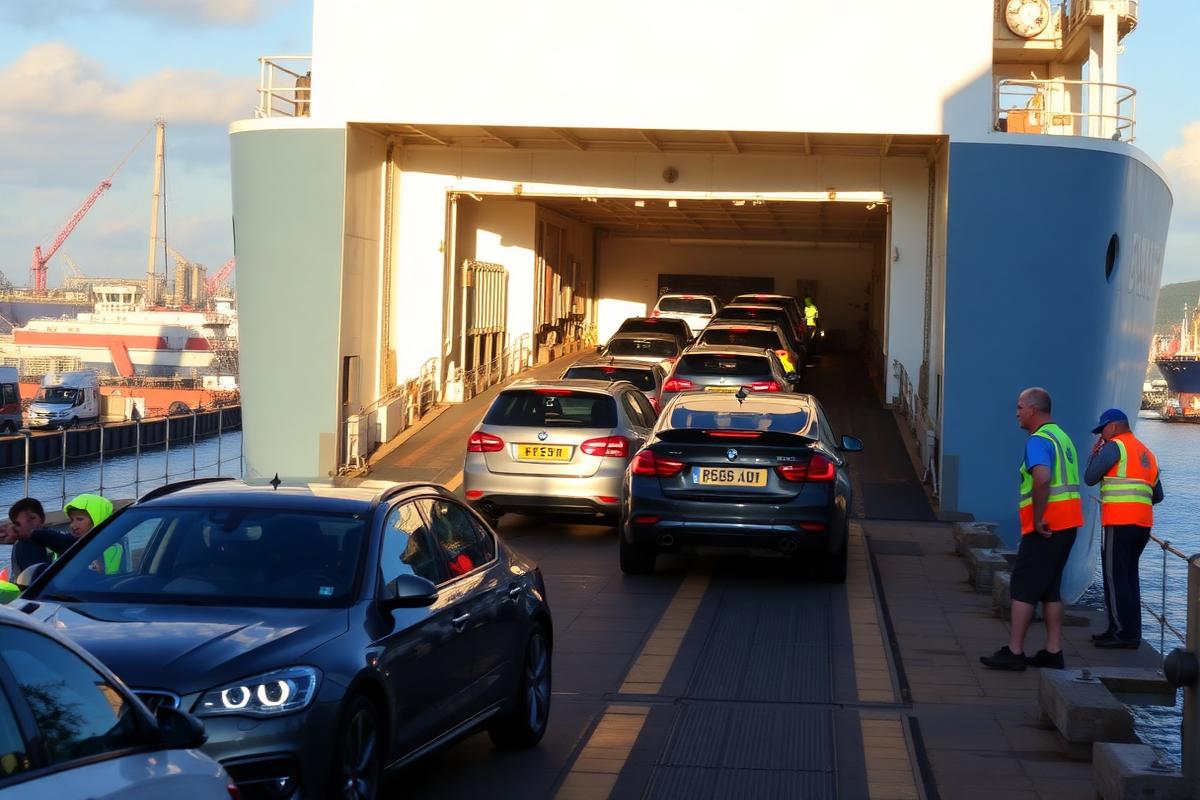
A RoRo vessel is best pictured as a floating multi-storey car park that crosses oceans. Your vehicle is driven up a stern or side ramp by a trained port driver, parked on one of several fixed decks inside the ship's hull, and lashed at the wheels using chains or webbing straps tensioned to a specification set by the vessel operator. Nothing loose may travel inside the vehicle, no boxes on the back seat, no bags in the boot, because customs and the carrier both require the car to be empty for inspection and because loose items become projectiles in heavy weather. The fuel tank must be kept to around a quarter full, both to reduce fire risk and to keep the vehicle light for the ramp gradient, and the vehicle must start, steer and brake reliably enough for a stranger to drive it safely through a busy terminal.
Pricing guide
Shipping Pricing Guide
Indicative UK export rates across air freight, vehicle shipping and container shipping
| Saloon car — RoRoUK port to destination port | from £695 |
| 20ft container (FCL) | from £1,450 |
| 40ft container (FCL) | from £2,050 |
| 40ft high cube container | from £2,190 |
| LCL groupageMinimum 2 m³ | from £95 per m³ |
| Air freight general cargo300 kg and above | from £2.85 per kg |
| UK collection & export entry | from £110 combined |
Indicative rates only, excluding VAT where applicable. Final pricing depends on dimensions, weight, sailing schedule and destination charges.
In exchange for these constraints, RoRo delivers the lowest freight rate available for a running vehicle and, on most trade lanes, the shortest port-to-port transit time, because RoRo vessels are purpose-built for speed of loading and discharge rather than general cargo handling. A vessel calling at Southampton or Tilbury can load hundreds of vehicles in a single working shift, which keeps port dwell time and therefore cost to a minimum. This efficiency is why RoRo remains the default choice for standard production cars moving in volume between the UK and destinations with dedicated RoRo terminal infrastructure, such as much of West Africa, the Middle East and continental Europe.
RoRo terminals in the UK operate to strict cut-off times, and the vehicle must be presented with a completed booking, a clean V5C or export documentation, and, where the buyer is overseas, proof that any outstanding finance has been cleared. Terminal staff conduct a visual condition survey on arrival, photographing the vehicle from all four corners and noting any existing damage, which becomes the reference point for any dispute on arrival. This survey is one of the most valuable parts of the RoRo process because it protects both the shipper and the carrier by establishing an agreed condition baseline before the vehicle ever leaves dry land.
How container shipping works
In a container the vehicle is winched, driven or forklifted into a 20ft or 40ft steel box at Car Shipping Direct's own packing facility, chocked at each wheel with timber blocks fixed to the container floor, strapped at four chassis points to prevent any movement, and photographed from every angle before the doors are closed and a numbered customs seal is fitted. A 20ft box holds one vehicle comfortably with room to spare for a modest quantity of spares or personal effects; a 40ft holds two vehicles side by side, or one vehicle plus a substantial volume of household goods, tools or auto parts, which makes it a popular choice for expatriates relocating with both a car and a container-load of belongings in the same shipment.
Because the container is sealed at the point of packing in the UK and is only opened by customs officials at the destination, handling damage and pilferage risk fall sharply compared with a method where the vehicle is exposed to open decks, weather and multiple sets of hands throughout the voyage. This is the primary reason owners of classic cars, high-value performance vehicles, and heavily modified builds specify container shipping even when a cheaper RoRo option exists on the same route, the premium buys a controlled, documented, single-handling journey from warehouse door to destination port.
Container loading also opens up destinations that have no RoRo ramp infrastructure at all. Many smaller ports and inland container terminals can only receive cargo by crane, lifting a sealed box directly from ship to quay or rail wagon, with no capacity to drive a vehicle off under its own power. For these destinations, container shipping is not simply the safer option, it is the only option, regardless of the type of vehicle being moved.
The packing process itself is worth understanding in detail. At the Car Shipping Direct facility, the vehicle is weighed, its odometer reading and fuel level are recorded, and a detailed condition report with time-stamped photographs is produced and shared with the customer before the container doors close. This report, combined with the numbered seal applied at packing, forms the documentary chain that a marine insurer or a destination customs officer will refer to if any question arises about the condition or contents of the shipment during transit.
Choosing between them
Choose RoRo when the vehicle is an ordinary running car in good mechanical order, the destination has an established RoRo terminal, and price is the deciding factor in the decision. This covers the great majority of private car exports from the UK, a family selling a car to a buyer in Ghana, a returning expatriate taking their daily driver to the UAE, or a dealer moving stock to a market with strong RoRo links. In these scenarios the cost saving of RoRo over container is substantial and the additional handling risk is, for a modern production car, genuinely modest.
Choose a container when the vehicle is a classic, a high-value or heavily modified unit, a non-runner that cannot be driven onto a RoRo ramp, or when you want to ship personal effects, spares or tools alongside the car in the same movement. Container is also the only realistic route to ports with no vehicle ramp, where the box is simply lifted off by crane onto the quay or directly onto a road trailer or rail wagon for onward inland transport.
Shared container loading is the middle path between these two extremes: you pay for the space your vehicle occupies inside a consolidated box rather than the cost of the whole unit, which brings container-grade protection close to RoRo pricing at the expense of a slightly longer wait while the container fills with other shippers' cargo. This option suits a buyer who wants the sealed-box security of container shipping but does not have a full 20ft or 40ft worth of cargo to justify a sole-use booking, and it is one of the most frequently booked services through Car Shipping Direct for exactly this reason.
A further factor worth weighing is insurance cost and claims experience. Because a RoRo vehicle sits exposed on deck or on a lower hold level throughout the voyage, minor scuffs from adjacent vehicle movement or lashing are, statistically, more commonly claimed against RoRo shipments than container shipments. This does not make RoRo an unsafe method, millions of vehicles cross oceans this way every year without incident, but it is a genuine, quantifiable difference that should factor into the decision for a vehicle where even minor cosmetic damage would be expensive or impossible to rectify at the destination.
Transit times and scheduling differences
RoRo services generally offer faster nominal transit times because the vessels are optimised for rapid loading and discharge rather than for carrying a diverse mix of general cargo. A RoRo sailing from Southampton to Durban, for example, will typically beat a container service on the same corridor by several days purely because of how quickly vehicles are driven on and off at each port of call. However, RoRo vessels also tend to make more intermediate port calls than a direct container service, and each additional call adds handling time and increases the theoretical exposure of the vehicle to further movement and lashing operations.
Container services, by contrast, often sail on fixed weekly schedules with published transit times that are highly predictable, because the vessel's rotation is fixed regardless of how full any individual container happens to be. This predictability matters most for shared container shipments, where the sailing date depends on the container reaching capacity, a popular consolidation lane out of Tilbury or Felixstowe to a busy destination such as Lagos or Mombasa might fill within a week, while a niche lane could take three to four weeks to complete, and this variability should be factored into any time-sensitive move.
Cost comparison across common UK export routes
On the UK-to-West-Africa corridor, RoRo typically undercuts container freight by a meaningful margin for a standard vehicle, which is why RoRo dominates this trade lane for ordinary production cars. On the UK-to-Middle-East corridor, servicing ports such as Jebel Ali, the gap narrows somewhat because container services on this route benefit from very high general cargo volumes that keep rates competitive, making container a genuinely close alternative rather than a significant premium.
On the UK-to-Australia and UK-to-New-Zealand corridors, container shipping is frequently the more practical choice regardless of price, because Australian and New Zealand biosecurity authorities apply exacting cleanliness standards that are far easier to guarantee and evidence in a sealed, single-handling container than on an open RoRo deck exposed to soil and organic matter from other vehicles and terminal equipment during transit and discharge.
On the UK-to-USA corridor, container shipping is the default for the simple reason that scheduled RoRo coverage between UK ports and US East Coast or Gulf ports is limited compared with other trade lanes. Buyers shipping to the United States should expect to use a shared or sole-use container as standard practice, and should separately budget for US EPA and DOT import compliance costs, which sit entirely outside the freight quotation.
Insurance and liability considerations for each method
Marine cargo insurance is available and strongly recommended for both RoRo and container shipments, but the underlying risk profile the insurer is pricing differs between the two. RoRo cover reflects the exposure of an unsealed vehicle to handling by multiple stevedores, movement of adjacent vehicles, and exposure to weather during loading and discharge. Container cover reflects a lower handling risk but a concentrated one, if a container is dropped, crushed, or subjected to serious wetting from a hold breach, the loss can affect the entire contents of the box rather than a single vehicle, so total-loss claims, while rarer, can be higher in absolute value per incident.
Whichever method is chosen, always confirm that cover is written under Institute Cargo Clauses A, the all-risk form, rather than a named-perils clause, and always declare the vehicle's true value rather than a conservative figure intended to reduce the premium, under-declaration triggers the average clause, under which an insurer only pays the proportion of a loss that the declared value bears to the vehicle's actual value, which can leave a claimant significantly out of pocket at the worst possible moment.
Frequently asked questions on RoRo versus container
Can I put personal effects in a RoRo vehicle? No, RoRo terminals and the vessel operator require the vehicle to be empty, both for security screening and because loose items are a genuine safety hazard during a rough crossing. Personal effects must travel separately or the vehicle must be switched to container shipping.
Is container shipping always safer? It is generally lower risk in terms of handling damage and weather exposure, but it is not risk-free, and the sealed nature of a container means any damage that does occur is typically only discovered when the box is opened at destination, which can complicate the timeline of a claim compared with the immediate visual inspection possible with RoRo loading and discharge.
Which is faster to book? RoRo bookings can often be confirmed within a day or two of enquiry given space on a scheduled sailing, whereas a shared container booking depends on the fill rate of the consolidation service, and a sole-use container booking depends on slot availability with the shipping line, which can vary from a few days to a couple of weeks depending on the route and season.
Does Car Shipping Direct offer both methods on every route? Coverage varies by destination and is confirmed at the time of enquiry, since RoRo terminal infrastructure and container consolidation schedules differ from port to port; our team will always recommend the method that best suits the vehicle and destination rather than defaulting to whichever is administratively easiest to arrange.
Collection and loading at Tilbury and other UK ports
Car Shipping Direct operates from East Tilbury, close to the Port of Tilbury's dedicated RoRo terminal, and the majority of vehicles we ship pass through this route rather than being trucked across the country to a more distant port. Self-delivery is welcomed by appointment: bring the vehicle to our yard with the V5C, a valid MOT if the car will be driven under its own power on site, and photographic identification matching the name on the export paperwork. Where self-delivery is not practical, our own collection service can retrieve the vehicle from anywhere in mainland UK on a flatbed or a trade plate driver, and this collection leg is quoted separately from the ocean freight so you can see exactly what each part of the journey costs.
On arrival at our yard or at the terminal itself, every vehicle undergoes a condition survey before it is accepted for shipment: four-corner photographs, a note of existing scuffs or stone chips, odometer reading and fuel level. This survey is not bureaucracy for its own sake, it is the document that protects you if a dispute over condition arises after discharge at the destination port, and we strongly recommend customers attend or photograph the vehicle themselves immediately beforehand as a personal record to sit alongside ours.
RoRo terminals work to fixed cut-off times ahead of each sailing, typically 24 to 72 hours depending on the vessel and destination, and a vehicle presented after cut-off will simply roll to the next scheduled sailing rather than being squeezed onto the booked one. Building a few days of slack into your collection date, rather than delivering the vehicle at the last possible moment, is the single easiest way to avoid an accidental week's delay.
Insurance for RoRo and container shipments
Marine cargo insurance is not automatically included in a freight quotation from any carrier, and carrier liability under the Hague-Visby Rules is capped at a level that bears no relationship to the real value of a modern vehicle. Car Shipping Direct offers marine insurance on every booking, written under Institute Cargo Clauses A, the broadest, all-risk form available, at a typical premium of around 1.5% of the vehicle's declared value. For a car worth £12,000, that is a modest sum measured against the cost of replacing the vehicle outright if the worst happens mid-voyage.
Declare the vehicle's true value rather than a conservative figure to reduce the premium. Under-declaring triggers the average clause, under which the insurer only pays out the same proportion of a claim as the declared value bears to the vehicle's real worth, a car under-declared by half will only recover half of any loss, regardless of the size of the claim. This is one of the most common and most painful mistakes we see among first-time shippers trying to save a small amount on premium.
Destination requirements that affect the RoRo versus container decision
Shipping to Australia or New Zealand tips the decision firmly towards container in most cases, because the Australian Department of Agriculture and New Zealand's Ministry for Primary Industries both apply strict biosecurity rules that require the vehicle's underbody, wheel arches and engine bay to be free of soil, seeds, insects and plant matter on arrival. A sealed container that has not been exposed to an open RoRo deck is far easier to present clean and to evidence as clean, and a failed inspection at either destination results in the vehicle being sent for compulsory steam cleaning at the importer's expense, with demurrage accruing throughout the delay.
Shipping to Nigeria and much of West Africa generally favours RoRo, but buyers should be aware that Nigeria operates a pre-shipment or destination inspection regime through the Nigeria Customs Service, and vehicles older than 12 years from the date of manufacture are currently barred from importation altogether. Confirming the vehicle's age against current Nigerian import rules before booking avoids the costly outcome of a vehicle arriving at Lagos or Port Harcourt only to be refused entry.
Shipping to the United States, regardless of RoRo or container method, is governed by the 72-hour rule under US Customs and Border Protection regulations: an Importer Security Filing (ISF) and an Automated Export System (AES) filing must both be lodged with US authorities at least 24 hours before the vessel loads at the UK port, not 24 hours before arrival in the US. Missing this filing window can result in the shipment being refused loading or the importer facing a significant penalty on arrival, so US-bound bookings should be confirmed with full consignee and vehicle details well in advance of the sailing date.
Shipping to the United Arab Emirates through Jebel Ali is comparatively straightforward by either method, but the UAE requires a certificate of conformity or an equivalent import permit for the vehicle to clear customs, and used vehicles over a certain age can face restrictions depending on the emirate of final registration. Confirming the receiving emirate's specific used-vehicle age policy with your consignee before shipping avoids a vehicle arriving to find it cannot be registered locally.
Typical timelines and costs in GBP
As a rough planning guide in pounds sterling, RoRo freight for a standard saloon from a UK port to West Africa typically starts in the low four figures once terminal handling is included, with transit times of two to four weeks depending on the specific port of discharge and the number of intermediate calls the vessel makes. The same vehicle by shared container to the same destination usually costs a few hundred pounds more but adds one to three weeks of consolidation time at the UK end while the container fills.
To Australia or New Zealand, container freight, generally the more practical choice for the biosecurity reasons set out above, typically runs to roughly one and a half to two times the West Africa RoRo figure, reflecting both the distance and the compulsory inspection regime, with transit times of five to eight weeks door to door being common. To the UAE, costs and transit times generally sit between the West Africa and Australasia figures, with most sailings completing in three to five weeks.
These figures are indicative and move with bunker fuel surcharges, currency exchange rates and seasonal demand, so always request a current written quotation rather than relying on a figure more than a few weeks old.
Common mistakes to avoid
Leaving personal effects in a vehicle booked for RoRo is the most frequent error we encounter, terminals require the car to be empty, and anything found during the pre-loading check will hold the vehicle back for inspection rather than simply being removed on the spot. Equally common is underestimating destination charges: a cheap RoRo quote that excludes destination terminal handling, customs clearance and duty is not a bargain, it is an incomplete picture, and the missing charges will still be invoiced by someone at the far end.
Booking a container shipment without first confirming the receiving port has crane facilities suited to the container type, and assuming a vehicle will clear a RoRo terminal without a valid MOT or working brakes, are both avoidable errors that our team checks for on every booking before confirming a sailing.